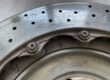
Repair of friction layer delamination and spalling on carbon-ceramic brake rotors

In early 2023, Rebrake GmbH developed a process that makes it possible to recondition worn carbon-ceramic brake discs by replacing the worn friction layer. Now, damage of all kinds can also be repaired in a sustainable manner.
This damage may be mechanical in nature, such as damage caused by carelessness when changing a wheel or during handling in the workshop; however, it may also involve what is known as delamination—the peeling away of the friction layer—which can occur suddenly during normal use. The cause of this is a failure of the bond between the base material and the friction layer.
The repair is performed by precisely applying the carbon/silicon carbide-containing material to the damaged area after it has been cleaned thermally and mechanically. In a high-temperature step in a vacuum atmosphere, the addition of silicon creates a chemically bonded composite between the friction layer and the substrate. The damaged area contains a friction layer made of the same type of material with a composition and hardness comparable to that of the original friction layer. Once the surface finish has been restored through precise fine grinding that meets the manufacturer’s tolerances, the brake disc can be used again safely and reliably.
Extensive testing has shown that brake discs repaired in this manner are just as durable and resilient as undamaged discs.
The benefit for customers and repair shops is that, from now on, damaged brake rotors—which often cost over €6,000—do not have to be completely replaced but can be repaired at a lower cost. This is a significant advantage for used cars or for repair shops, where even minor damage can often result in high costs during operations.
Rebrake Ceramic Service GmbH, Bayreuth, September 25, 2024