


Our Service


This is how your brake discs come to us and back again
The renewal process will take approximately 20 days. Ceramic brake discs that have already been reconditioned are sometimes also available immediately from stock in exchange. We always try to keep the most common brake discs available from stock. In this case, we retain a deposit of € 1.000 per brake disc
We can repair these types of damage

Detachment of the friction layer from the substrate due to loss of adhesion, which worsens as oxidation progresses.
Damage Type A: Delamination
Cause:
Delamination occurs when the bond between the friction layer and the backing material of the brake disc breaks down. As a result, parts of the friction layer peel away. This process typically occurs only after prolonged use and constitutes a safety hazard. The exposed areas leave the backing material unprotected, allowing oxidation to set in and causing the delamination to progress further.
Repair:
The damaged areas are repaired by selectively applying new wearing course material. This process is carried out under high-temperature conditions, ensuring that the material forms a strong, bond-type connection with the base material once again.
As part of the repair process, the entire brake disc undergoes a comprehensive overhaul. This includes repairing any additional damage to the friction layer, inspecting and overhauling all fasteners, and replacing them as needed. In addition, exposed edges are treated with an effective anti-corrosion coating.

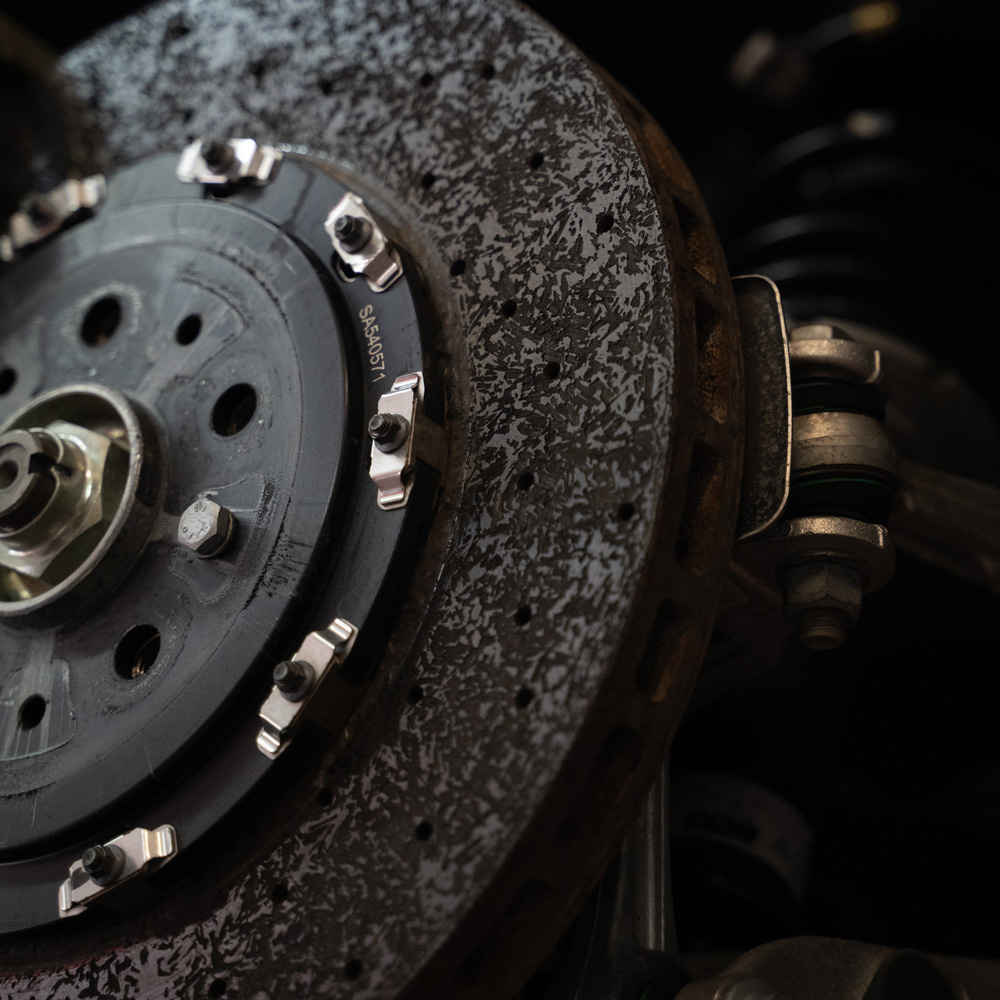
Material wear of the friction layer caused by normal braking operation, down to the wear limit.
Damage Type B: Abrasive Wear
Cause:
Abrasive wear is caused by continuous friction between the brake pad and the brake disc. As a result, the friction layer of the carbon-ceramic brake disc is gradually worn away over time. This process is normal and inherent to the design, but as mileage increases, it leads to a measurable reduction in the thickness of the friction layer.
Typically, wear affects the top layer of the brake disc to a depth of about 1–1.5 mm, while the structural core of the disc generally remains undamaged.
If a certain wear limit is exceeded, the brake disc’s performance can no longer be fully guaranteed. This can lead to reduced friction, uneven braking performance, or thermal overload, and thus poses a safety hazard.
Repair:
As part of the repair process, the worn friction layer is completely removed and the surface is specifically prepared for rebuilding. The friction layer is then rebuilt using a high-temperature process (liquid silicidation), which creates a new, high-strength Si/SiC friction layer.
The reactive bond with the substrate creates a permanently adherent and highly durable surface with excellent friction and wear properties.
Since the load-bearing core of the brake disc is preserved in most cases, the disc can be fully remanufactured and restored to like-new condition. Its mechanical and thermal properties match those of a new brake disc or may even exceed them in certain areas.

Mechanical chipping at the edges or on the surface that exposes the substrate and promotes oxidation.
Damage Type C: Edge Damage
Cause:
Edge and surface damage is caused by mechanical impacts, such as stone chips, improper handling, or foreign objects. Typical signs of damage include chipping along the edge or on the friction surface of the brake disc, which may result in a technical complaint.
A major problem here is the exposed backing material: Without a protective wear layer, the exposed carbon is susceptible to oxidation, which can cause the damage to worsen during continued use.
Such damage is often classified as requiring repair during inspections (e.g., by the TÜV) or according to the vehicle manufacturer’s specifications.
Repair:
Damaged areas are filled locally with a silicon-based material. This is followed by pyrolysis under controlled conditions, which restores the structural bond with the base material.
This process prevents secondary damage such as cracking or further material delamination and restores the structural integrity and operational safety of the brake disc.
The brake disc is then resurfaced to ensure a uniform surface. Minor repair areas are usually barely visible afterward, and the necessary protection against oxidation is fully restored.
Uneven wear causes the brake disc to become warped, resulting in noticeable vibrations when braking.
Damage Type C: Vibrations
Cause:
Vibrations during braking are often caused by uneven wear of the friction layer, which results in the brake disc no longer being flat and parallel. This type of wear is particularly common in carbon-ceramic brake discs (e.g., Audi’s CCB systems) and leads to what is known as thickness variation or out-of-roundness.
Due to the uneven surface, the brake pad no longer makes even contact with the brake rotor. This causes fluctuating friction forces during braking, which result in noticeable vibrations in the steering wheel and brake pedal.
Repair:
To repair the damage, the brake disc is first removed and disassembled into its individual components. Then, both the friction rings and all fasteners are thoroughly cleaned and inspected.
After professional reassembly, the friction surfaces are machined with precision. The brake disc is ground to be flat and parallel in accordance with the manufacturer’s specifications, thereby restoring an even contact surface for the brake pads.
This process eliminates vibrations and fully restores the original braking performance.
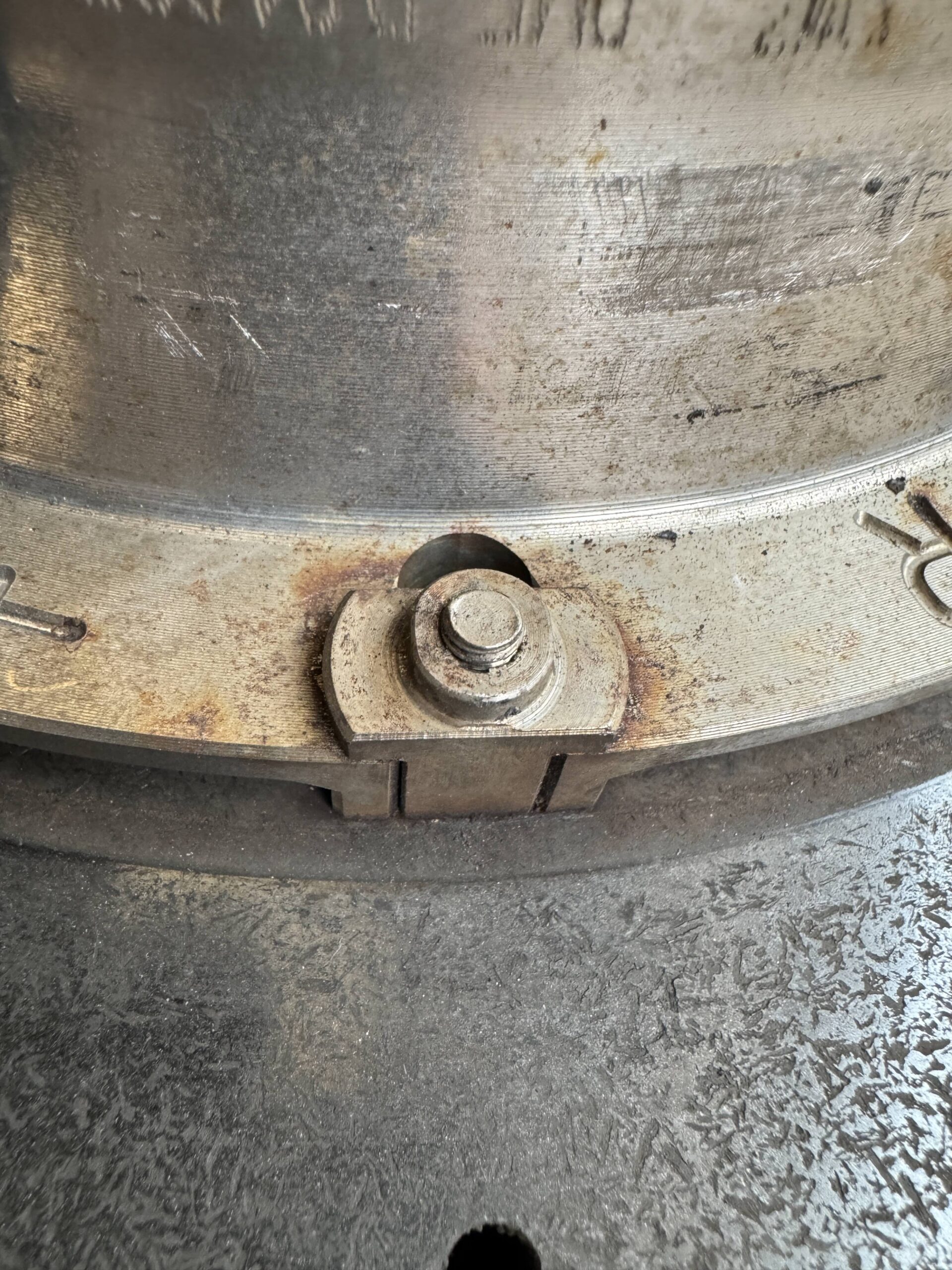
Fasteners that are corroded or damaged restrict movement and can cause noise or cracks.
Damage Type E: Corroded fasteners
Cause:
Contact corrosion, thermal stress, or material fatigue can damage fasteners such as screw connections and so-called “floaters” or render them unusable. In many cases, these fasteners become firmly corroded in the area where they come into contact with the ceramic material and lose their mobility.
Floaters are essential to the proper functioning of the brake disc, as they must evenly transfer torque from the disc to the wheel hub while compensating for thermal expansion. If this mobility (“floating”) is restricted or no longer present, it can lead to uneven stress distribution and, in the worst case, cracking of the material.
In addition, defects in fasteners often manifest themselves as noises during operation.
Repair:
Damaged or severely corroded fasteners are professionally removed and replaced with new components. In particular, the floaters are replaced to fully restore the necessary mobility and functionality.
Replacing these components can significantly extend the service life of the brake disc and ensure its long-term operational safety.
We also offer matching bolt-on and floater sets for a wide range of brake disc types. We would be happy to review your request on a case-by-case basis and put together the appropriate components for your system.
Prices
1. Repair of damage such as delamination or edge damage
1970,- € plus VAT
2. Recoating
2.250,- € plus VAT
3. Precision grinding (in case of vibrations)
1.200,- € plus VAT
4. Overhaul of Screw Connections (Fastening Elements)
500,- € plus VAT
plus materials for the floaters if they are severely corroded
Delivery time
Delamination / Edge Damage / Recoating
approx. 20 – 25 Days
Vibrations / Overhaul of Screw Connections (Fastening Elements)
approx. 5 Days
Partner Workshops
These shops have experience with Rebrake and offer to remove the brake rotors and send them to Rebrake; while the work is being done, your vehicle will be safely stored on-site.
Eastern Germany:
ATR Autotechnik Rimpler
Lichterfelder Weg 21A, 14167 Berlin, 030-26566021
Central Germany:
Hermann Rüttger GmbH
Pleutersbacher Str. 30, 69412 Eberbach , 06271-4391
Southern Germany:
GT Sportscars GmbH
Seefelder Str. 54, 82211 Herrsching am Ammersee, 0170 -5757170
Northern Germany:
Nogaro Automotive GmbH
Trinidadstraße 7, 27356 Rotenburg , 01523-1957041